Using Pidgey
This tutorial is the same as Milky Way Orbit.
It uses pidgey to streamline the interface to the galactic dynamics packages.
from commensurability.tessellation import Tessellation

# plotting
from matplotlib import pyplot as plt
Define a Milky Way potential with your package of choice.
Initialize the corresponding backend with pidgey.
import pidgey
backend = pidgey.AgamaBackend()

import agama
agama.setUnits(length=1, mass=1, velocity=1)  # 1 kpc, 1 Msun, 1 km/s

from example_mw_bar_potential_new import makePotentialModel
potential = makePotentialModel()
Potential Definition
This example imports the Milky Way potential definition from here.
Define initial conditions using astropy and perform the orbit integration routine.
import astropy.coordinates as c
import astropy.units as u

ics = c.SkyCoord(
    x = 4 * u.kpc,
    y = 0 * u.kpc,
    z = 1 * u.kpc,
    v_x = 0 * u.km/u.s,
    v_y = 250 * u.km/u.s,
    v_z = 0 * u.km/u.s,
    frame="galactocentric",
    representation_type="cartesian",
)
coords = backend.compute_orbit(ics, potential, 0.005 * u.Gyr, 200)
Extract the orbit points and plug them into Tessellation.
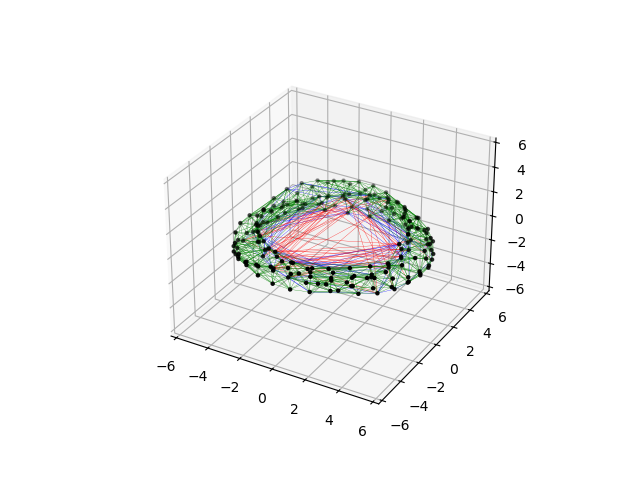
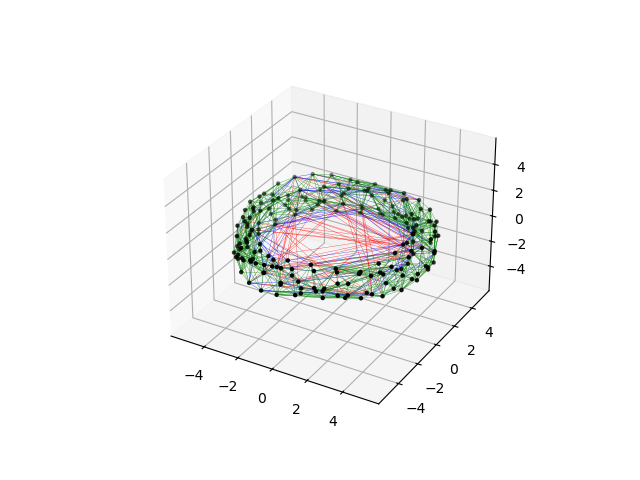
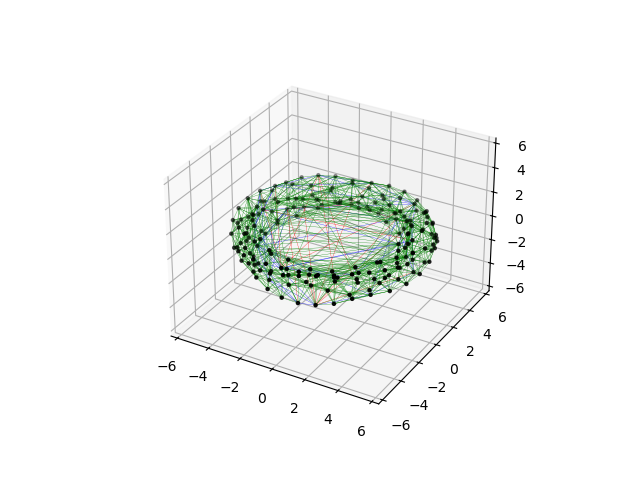
The tessellation can then be plotted.
fig = plt.figure()
ax = fig.add_subplot(111, projection='3d')
tess.plot(ax, plot_removed=True)
plt.show()